Key takeaways
- ✓The General Residential Zone (Clause 32.08) is Victoria's most common residential zone — a moderate-growth, up-to-three-storey zone.
- ✓A planning permit is always required for two or more dwellings on a lot in the GRZ; a single dwelling on a lot 300 square metres or more is often exempt.
- ✓The standard GRZ height is a mandatory 11 metres and 3 storeys, unless a schedule sets a different figure.
- ✓The minimum garden area requirement applies in the GRZ — 25 to 35 per cent of the lot, depending on lot size.
- ✓Always read the schedule (GRZ1, GRZ2, etc.) — it can change the height, add permit triggers and vary standards for your street.
The General Residential Zone (GRZ) in Victoria Explained
The General Residential Zone (GRZ) is the workhorse of Victoria's residential land — the zone most suburban homes sit in. It's a moderate-growth zone that supports a mix of housing up to three storeys while still protecting neighbourhood character. If your property is zoned GRZ, the zone sets out what you can build, when you need a planning permit, and the height, garden area and design standards your project has to meet.
Get a council-ready town planning report in 5 minutes — no town planner, no waiting.
Get your report →- ✓What the General Residential Zone is for and what it allows
- ✓When a planning permit is required in the GRZ
- ✓The standard 11-metre, three-storey height rule — and when a schedule changes it
- ✓How the minimum garden area requirement applies
- ✓How the GRZ differs from the NRZ and RGZ
The short answer
The General Residential Zone (Clause 32.08) is Victoria's standard residential zone, allowing housing up to three storeys. A planning permit is always needed for two or more dwellings on a lot, while a single dwelling on a lot of 300 square metres or more is often permit-exempt. The default height is a mandatory 11 metres, and the minimum garden area requirement applies.
The detail that matters most is in the schedule — GRZ1, GRZ2 and so on — which can change the height, add local permit triggers and vary the standards for your particular area.
What the General Residential Zone is for
The GRZ is set out in Clause 32.08 of the Victoria Planning Provisions. Its purpose is to encourage development that respects neighbourhood character while allowing moderate housing growth and diversity, in areas where housing of up to three storeys exists or is planned for. It sits in the middle of Victoria's residential hierarchy: more permissive than the Neighbourhood Residential Zone, but less intense than the Residential Growth Zone.
In practice, the GRZ allows the full range of suburban housing — single dwellings, dual occupancies, townhouses and low-rise apartments — subject to a planning permit where the scheme requires one.
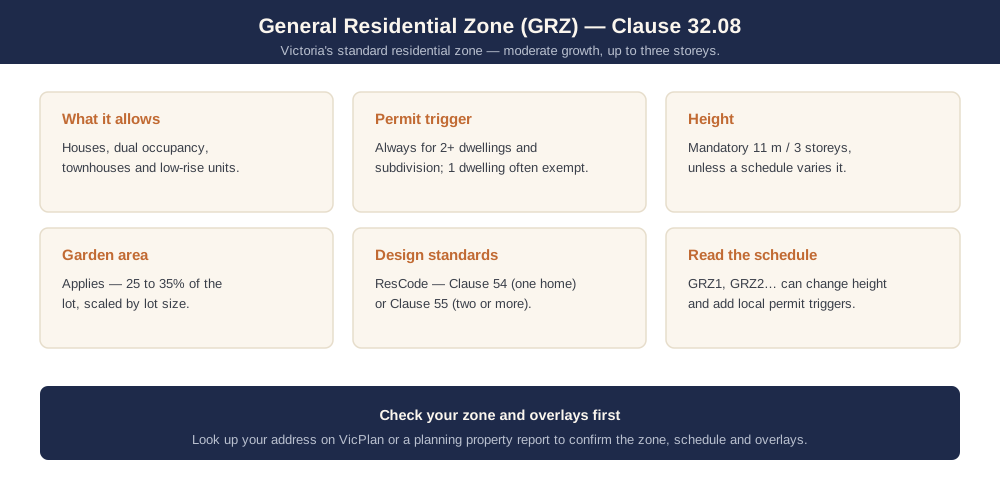
Figure 1: The General Residential Zone allows a range of housing, with permit triggers, a mandatory height and a garden area requirement on top.
When do you need a planning permit in the GRZ?
Spend 5 minutes, not 3 weeks
instantplanning generates a council-ready town planning report for Victorian permits. No town planner. No waiting.
Get your report →Whether you need a planning permit in the GRZ depends on what you're proposing. The clause draws a clear line between one dwelling and two or more.
- ✓One dwelling on a lot of 300 square metres or more — usually no planning permit (unless a schedule or overlay says otherwise)
- ✓One dwelling on a lot smaller than 300 square metres — a permit is required
- ✓Two or more dwellings on a lot (dual occupancy, townhouses, units) — a permit is always required
- ✓Subdividing land — a permit is always required
- ✓Any building or works in an overlay (heritage, bushfire, flood, vegetation) — a permit is usually required
The two-or-more-dwellings trigger is mandatory statewide — a schedule can't waive it. The single-dwelling exemption above 300 square metres is the base position, but a GRZ schedule can tighten it (for example, requiring a permit for a single dwelling on lots under 500 square metres), and any overlay on your land can independently trigger a permit. That's why checking your overlays — not just your zone — is essential. See do I need a planning permit in Victoria for the full picture.
The 11-metre, three-storey height rule
The GRZ is a three-storey zone. Where the schedule doesn't specify a different figure, the standard control is a mandatory maximum building height of 11 metres and no more than 3 storeys.
Two points often catch people out. First, this is a mandatory maximum, not a discretionary target — you can't simply ask the council to exceed it on its merits (limited, tightly-defined exceptions aside, such as replacing a pre-existing taller building). Second, a schedule can vary the height: some GRZ schedules set a lower figure such as 9 metres and 2 storeys for character reasons, while others lift it in well-located areas. Whatever the schedule says becomes the mandatory control for that land. If an overlay also sets a height, the lowest applicable limit governs. We cover the mechanics in building height for residential development in Victoria.
The garden area requirement
The GRZ is one of only two residential zones — with the NRZ — where the minimum garden area requirement applies. It's a mandatory control: a permit can't be granted for development or subdivision that fails to meet it, and a building surveyor must also check it where no planning permit is required.
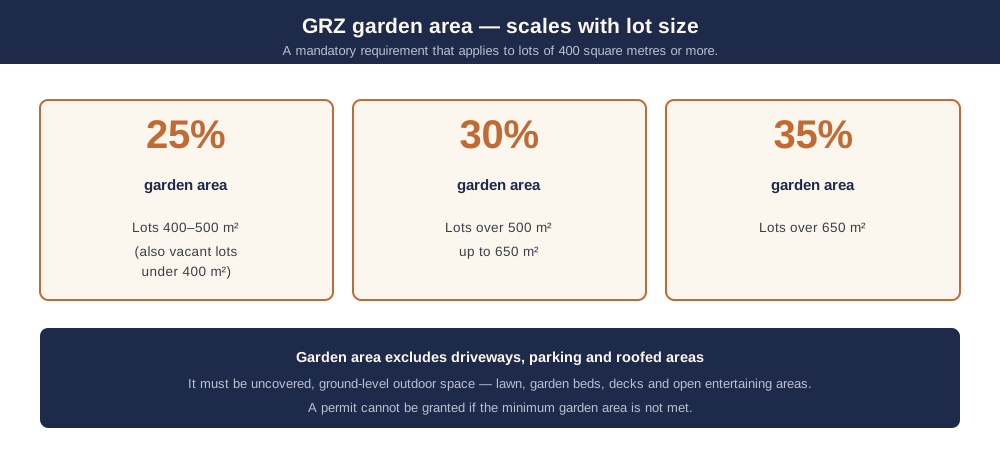
Figure 2: The percentage of the lot that must be set aside as garden area increases with lot size in the GRZ.
For existing lots of 400 square metres or more, the percentage scales by lot size:
- ✓400 to 500 square metres — at least 25 per cent garden area
- ✓More than 500 and up to 650 square metres — at least 30 per cent
- ✓More than 650 square metres — at least 35 per cent
Garden area is broadly the uncovered, ground-level outdoor space — lawns, garden beds, decks and the like — but it excludes driveways, car parking and any roofed area. For the full definition and worked examples, see the garden area requirement in Victoria.
ResCode: Clause 54 and Clause 55
If a permit is required, your development is assessed against Victoria's residential development standards — still widely called ResCode. Which clause applies depends on how many dwellings you're building:
- ✓Clause 54 applies to one dwelling (and certain small second dwellings) on a lot.
- ✓Clause 55 — now the Townhouse and Low-Rise Code — applies to two or more dwellings on a lot, and residential buildings up to and including three storeys.
Under the reformed Clause 55, the site coverage benchmark for the GRZ is 65 per cent. These standards cover setbacks, site coverage, private open space, overlooking and overshadowing, and your town planning report needs to address each one for your zone and schedule. For an overview, start with what is ResCode in Victoria, then read Clause 54 explained or Clause 55 for townhouses and low-rise.
GRZ vs the other residential zones
The GRZ sits between the more restrictive NRZ and the higher-density RGZ. The differences come down mostly to height and the garden area requirement.
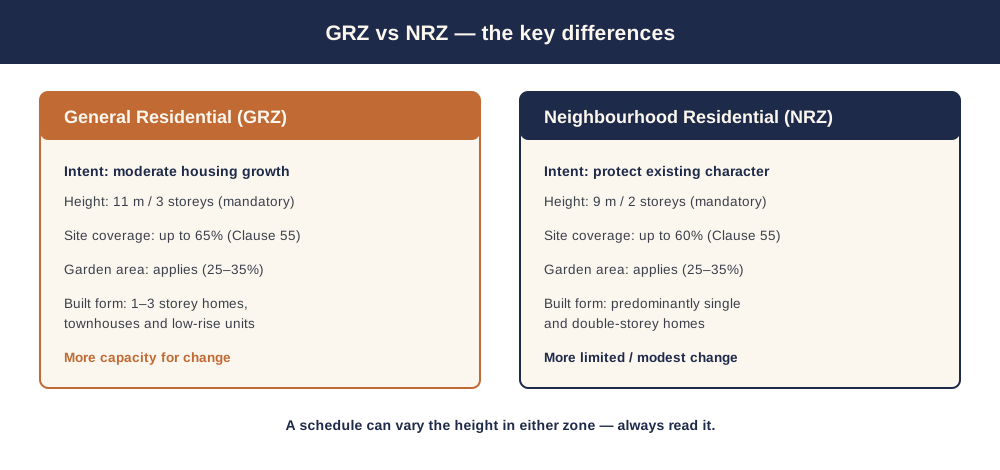
Figure 3: The GRZ allows greater height and site coverage than the NRZ, while both apply the garden area requirement.
The Neighbourhood Residential Zone (NRZ) is more restrictive — a mandatory 9 metres and 2 storeys, with stronger character protection — while the Residential Growth Zone (RGZ) is the most intense, with a discretionary 13.5-metre height and no garden area requirement. Confirm which zone applies to your land before you assume anything: look up your address on VicPlan or generate a planning property report.
If your GRZ project needs a permit
If your project triggers a planning permit, your application is far stronger — and far less likely to be returned or hit a Request for Further Information — when it's supported by a town planning report that addresses Clause 32.08, your schedule, any overlays and the relevant ResCode standards.
Hiring a town planner can take weeks. instantplanning builds the same council-ready report from current Victorian planning scheme data in minutes — you review it before you lodge. Start with what a town planning report is, or just generate your report.
Frequently asked questions
What does General Residential Zone mean in Victoria?
Do I need a planning permit in the General Residential Zone?
What is the maximum building height in the GRZ?
Does the garden area requirement apply in the GRZ?
How many dwellings can I build in the GRZ?
What's the difference between the GRZ and the NRZ?
Ready to generate your report?
Skip the writing. Get a council-ready town planning report in 5 minutes.
Get your report