Key takeaways
- ✓Clause 55 is the Townhouse and Low-Rise Code — the ResCode pathway for two or more dwellings on a lot and residential buildings up to and including three storeys.
- ✓Amendment VC267 rebuilt Clause 55 on 31 March 2025 into a deemed-to-comply code with updated standards.
- ✓Meeting every applicable standard removes the council's discretion to refuse on those grounds and removes third-party appeal rights.
- ✓Its standards cover street setback, site coverage, side and rear setbacks, private open space, overshadowing and overlooking.
- ✓Confirm the exact figures for your zone with your council, as standards differ by zone.
Clause 55: Townhouse & Low-Rise Code (VIC)
If you are planning two townhouses, a small unit development, or any project with more than one dwelling on a lot in Victoria, Clause 55 is the part of the planning scheme you will be measured against. Rebuilt by Amendment VC267 on 31 March 2025 as the Townhouse and Low-Rise Code, it now runs on a rules-based, deemed-to-comply system designed to make low-rise housing approvals faster and more predictable.
Get a council-ready town planning report in 5 minutes — no town planner, no waiting.
Get your report →- ✓What Clause 55 is and when it applies
- ✓What the VC267 reform changed
- ✓How the deemed-to-comply pathway works
- ✓The standards Clause 55 measures
- ✓How it fits your application
The short answer
Clause 55 is the Townhouse and Low-Rise Code in the Victorian planning scheme — the ResCode pathway for two or more dwellings on a lot and residential buildings up to and including three storeys. Reformed by Amendment VC267 in March 2025, it uses deemed-to-comply standards, so meeting every applicable standard removes the council's discretion to refuse on those grounds and removes third-party appeal rights.
The pathway and its payoff are shown below.
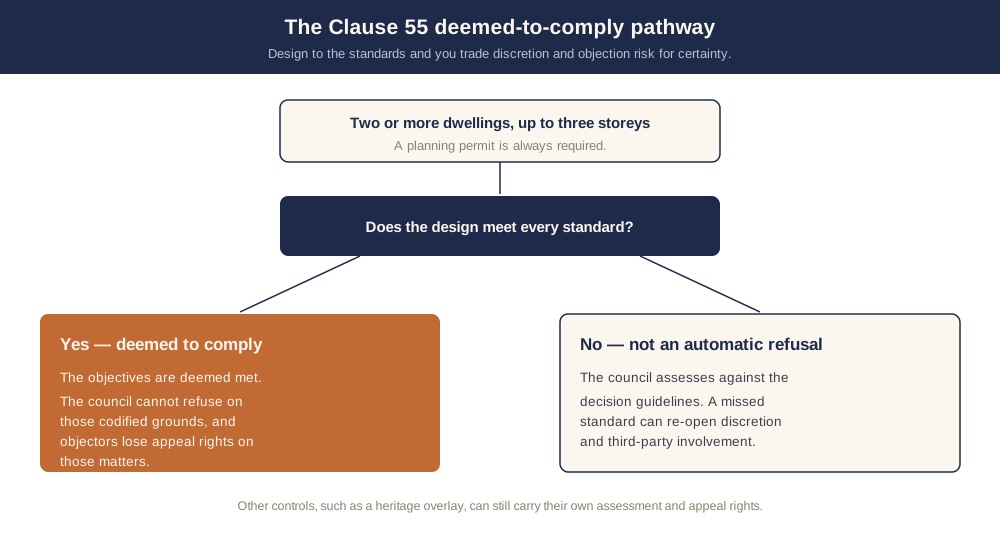
Figure 1: Meet every applicable Clause 55 standard and the assessment narrows to a faster, more certain decision.
When Clause 55 applies
Clause 55 applies to two or more dwellings on a lot and to residential buildings up to and including three storeys in the residential zones the scheme nominates. One dwelling on a lot is assessed under Clause 54, the Single Home Code instead, and a four-storey apartment development falls under Clause 57, the Four Storey Apartment Code.
A planning permit is always required for the development Clause 55 covers — there is no permit-exempt path for two or more dwellings. So unlike a single home, you will reach Clause 55 whenever you propose a dual occupancy or townhouse project. For the permit picture, see do I need a planning permit for townhouses in Victoria.
What Amendment VC267 changed
Spend 5 minutes, not 3 weeks
instantplanning generates a council-ready town planning report for Victorian permits. No town planner. No waiting.
Get your report →VC267, gazetted on 31 March 2025, was the biggest shake-up of the townhouse rules in years. It rebuilt Clause 55 around a deemed-to-comply model and updated the numbers behind many standards to make compact, low-rise housing easier to approve.
- ✓A deemed-to-comply assessment process for two or more dwellings up to three storeys
- ✓A reduced front street setback standard of 6 metres, replacing the former 9-metre average
- ✓Updated site coverage standards that differ by residential zone
- ✓Revised overshadowing and overlooking standards with updated metrics
- ✓Removal of third-party appeal rights where all applicable standards are met
The reform sat alongside the rebuild of Clause 54 into the Single Home Code, so both the single-dwelling and multi-dwelling pathways now share the same deemed-to-comply logic. We set out the wider picture in what is ResCode.
How the deemed-to-comply pathway works
Like all ResCode provisions, each Clause 55 standard pairs an objective with a measurable standard and decision guidelines. What VC267 sharpened is the consequence of meeting them.
If your design meets a standard, the matching objective is deemed satisfied, and the council is not required to consider the decision guidelines — or other competing policy — for that matter. If your design meets every applicable standard, two powerful things follow: the council cannot refuse the application on those codified grounds, and objectors lose the right to appeal to the tribunal on those matters. That is the trade at the heart of the reform — certainty in exchange for designing to the rules.
If you miss a standard, the proposal is not automatically refused. The council assesses it against the decision guidelines, but a missed standard can re-open discretion and, depending on the trigger, restore third-party involvement. Other controls — a heritage overlay, for example — can still carry their own assessment and appeal rights independently of Clause 55.
The standards Clause 55 measures
Clause 55 works through a familiar set of built-form and amenity standards, recalibrated for multi-dwelling sites.
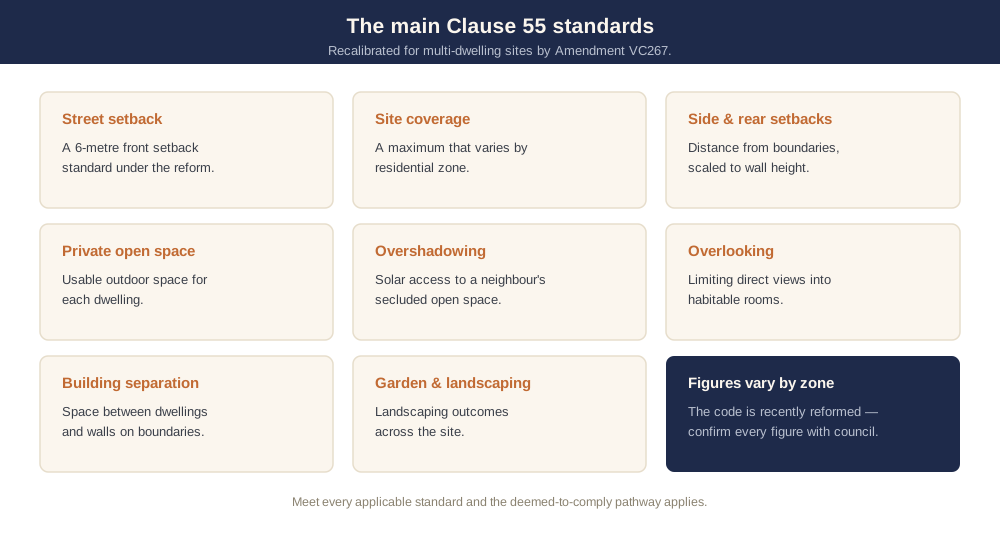
Figure 2: The recurring Clause 55 standards — confirm the exact figures for your zone with your council.
- ✓Street setback — a 6-metre front setback standard under the reformed code
- ✓Site coverage — a maximum that varies by zone, lower in Neighbourhood Residential and higher in Residential Growth zones
- ✓Side and rear setbacks — distance from boundaries, scaled to wall height
- ✓Private open space — usable outdoor space for each dwelling
- ✓Solar access and overshadowing — protecting a neighbour's secluded open space
- ✓Overlooking — limiting direct views into habitable rooms and open space
- ✓Walls on boundaries and building separation between dwellings
Some figures are confirmed in the reformed code — the 6-metre front setback, for instance — while site coverage steps up by zone, sitting lower in the Neighbourhood Residential Zone and higher in the Residential Growth Zone. Because the numbers shift by zone and the reform is recent, read your own scheme's Clause 55 and confirm every figure with your council before you rely on it. The related site coverage and private open space guides go deeper on those two.
How Clause 55 compares to the neighbours
It helps to see Clause 55 against the clauses on either side of it.
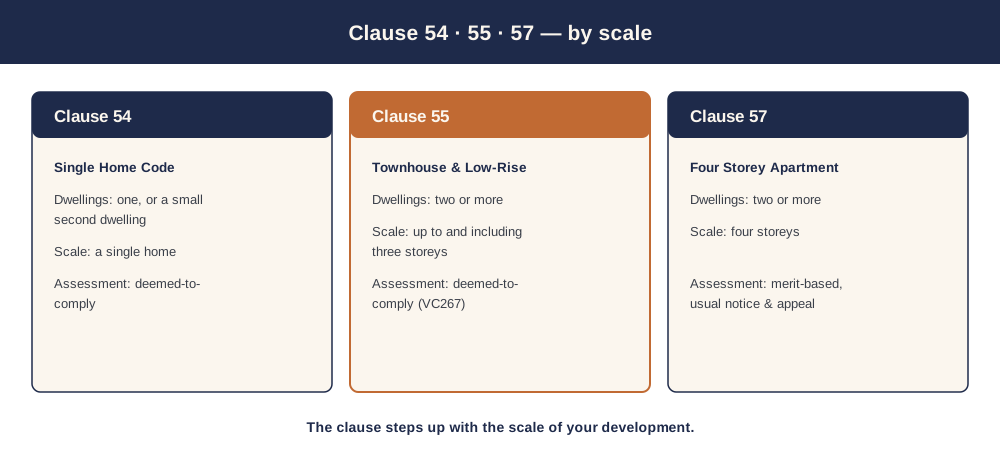
Figure 3: Clause 55 sits between the single-home code and the four-storey apartment code.
The progression is by scale: one dwelling (Clause 54), two or more up to three storeys (Clause 55), and four storeys (Clause 57). Notably, Clause 57 does not use the deemed-to-comply shortcut — it remains a merit-based assessment with the usual notice and appeal rights — so the certainty Clause 55 offers is a genuine advantage for low-rise projects that can design to its standards.
Putting Clause 55 to work in your application
A townhouse town planning report has to assess your design against every applicable Clause 55 standard — stating the objective, the standard, and how the design meets it — because meeting them all is what unlocks the faster, lower-risk pathway. Leaving a standard unaddressed is the most common reason a council issues a request for further information, which can stop the statutory clock.
This clause-by-clause discipline is exactly what a well-built tool delivers reliably. instantplanning assembles a council-ready report from current Victorian planning scheme data in minutes — working through your zone, overlays and each Clause 55 standard — where a town planner would take weeks. You review every line before you lodge. Start with what a town planning report is, or generate your report. For complex or contested sites, engage an experienced human planner.
Frequently asked questions
What is Clause 55 in Victoria?
What did Amendment VC267 change?
What does deemed-to-comply mean under Clause 55?
When does Clause 55 apply instead of Clause 54?
Do I still need a planning permit if I meet every Clause 55 standard?
Where do I find the Clause 55 figures for my site?
Ready to generate your report?
Skip the writing. Get a council-ready town planning report in 5 minutes.
Get your report