Key takeaways
- ✓Townhouses always need a planning permit in residential zones
- ✓Assessed against Clause 55, the Townhouse and Low-Rise Code
- ✓The 2025 reform added a deemed-to-comply pathway to three storeys
- ✓Garden area, 11 m height and later subdivision all apply
Do I Need a Permit for Townhouses? (VIC)
Yes — building townhouses in Victoria means putting two or more dwellings on a lot, and that always requires a planning permit in the residential zones. There's no exempt version of a townhouse project, but there is a clear, codified way the application is assessed, and a 2025 reform has changed it in your favour.
Get a council-ready town planning report in 5 minutes — no town planner, no waiting.
Get your report →- ✓Why two or more dwellings on a lot always triggers a permit
- ✓What Clause 55 (the Townhouse and Low-Rise Code) assesses
- ✓How the 2025 deemed-to-comply pathway can speed things up
- ✓The garden area, height and other standards your design must meet
- ✓Why selling the townhouses separately needs a second permit to subdivide
The short answer
Yes. Constructing two or more dwellings on a lot is a planning permit trigger in the General Residential, Neighbourhood Residential and Residential Growth Zones, so every townhouse development needs a planning permit. It is assessed against Clause 55 — the Townhouse and Low-Rise Code — for buildings up to and including three storeys.
Unlike a single house, which is often permit-exempt for planning, a townhouse project can never slip under the radar. The moment you propose a second dwelling on the lot, the responsible authority (your council) has to assess it. The decision steps are shown below.
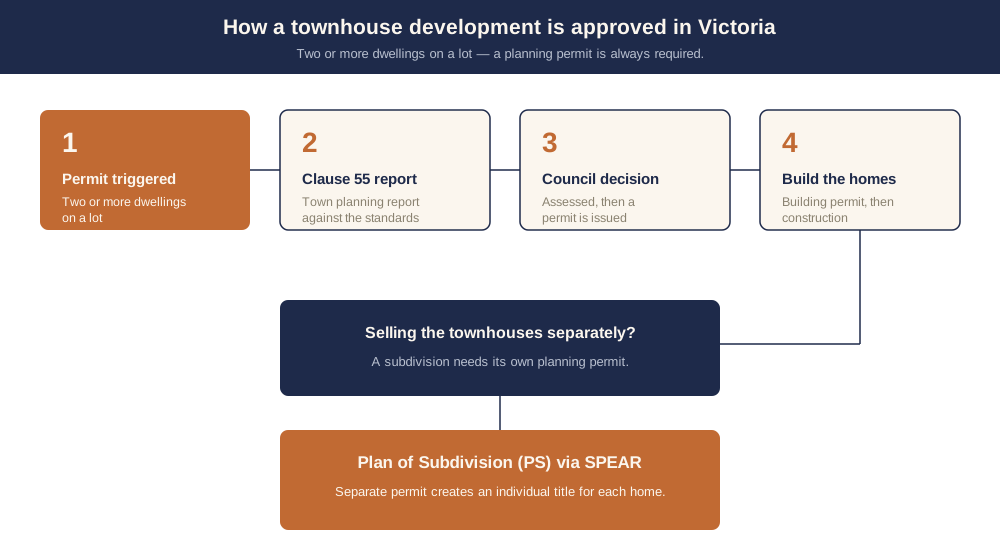
Figure 1: A townhouse project always begins with a planning permit, is assessed against Clause 55, then is built and (usually) subdivided.
Why townhouses always need a planning permit
In the residential zones, the zone provisions require a permit to construct two or more dwellings on a lot, to construct a second dwelling where one already exists, and to construct or extend a residential building. A townhouse development satisfies the first of those by definition.
This applies across the General Residential Zone, the Neighbourhood Residential Zone and the Residential Growth Zone, as well as some mixed-use and township zones. The planning scheme — not your builder or designer — decides the assessment, and for multi-dwelling work the scheme is unambiguous: a permit is always required. The state's own guidance confirms that "a planning permit is always required for these developments in the residential zones."
That makes a town planning report central to a townhouse application. The report demonstrates, standard by standard, how your design responds to neighbourhood character, amenity and the relevant requirements, so the council can make its decision without sending the application back.
What Clause 55 (the Townhouse and Low-Rise Code) assesses
Spend 5 minutes, not 3 weeks
instantplanning generates a council-ready town planning report for Victorian permits. No town planner. No waiting.
Get your report →Clause 55 of the Victoria Planning Provisions is the assessment framework for two or more dwellings on a lot and residential buildings up to and including three storeys. Since the 2025 reform it is known as the Townhouse and Low-Rise Code. It sits alongside its neighbours: Clause 54 covers a single dwelling on a lot, and Clause 58 covers apartment developments (generally four or more storeys, under the Better Apartment Design Standards). Townhouses live squarely in Clause 55 territory.
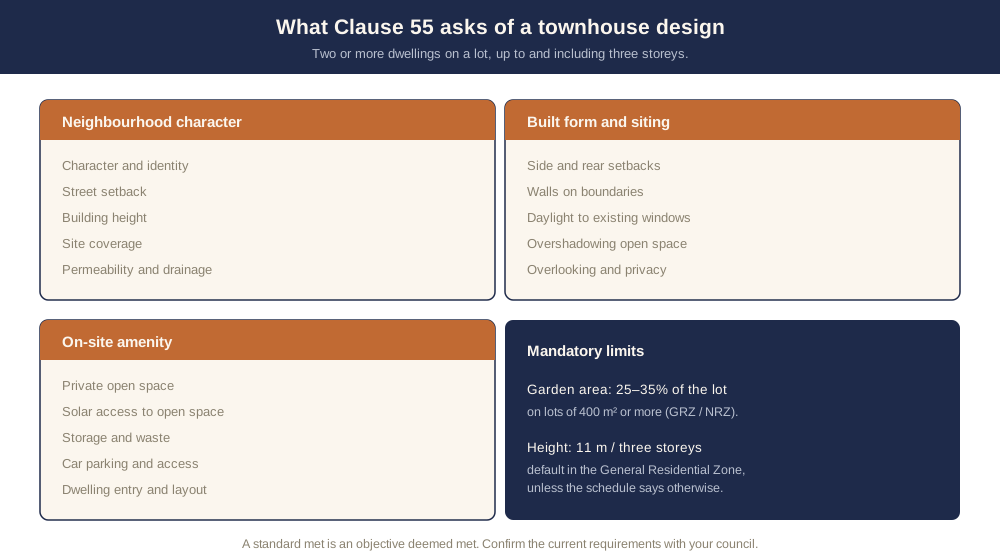
Figure 2: The Clause 55 standards group into neighbourhood character, built form, on-site amenity and the mandatory garden area.
Clause 55 is built around objectives, standards and decision guidelines covering matters such as neighbourhood character, street setback, building height, site coverage, side and rear setbacks, walls on boundaries, overshadowing, overlooking, private open space and car parking. A complete townhouse report walks through each relevant standard and shows how the proposal meets the objective — or, where it varies a standard, why the objective is still achieved.
The 2025 Townhouse and Low-Rise Code reform
This is the part worth understanding before you design. The Townhouse and Low-Rise Code reform was approved on 6 March 2025 and commenced on 31 March 2025, reworking the content of Clause 55. It did not create a new clause — the work stayed at Clause 55 — but it introduced a deemed-to-comply assessment pathway for townhouses and low-rise buildings up to and including three storeys.
Here's what deemed-to-comply means in practice. If your design meets a standard, the corresponding objective is deemed to be met, and the responsible authority isn't required to consider the related decision guidelines for that matter. An application that meets the relevant requirement can't be refused on the basis of that requirement. The pathway is designed for faster, more certain decisions.
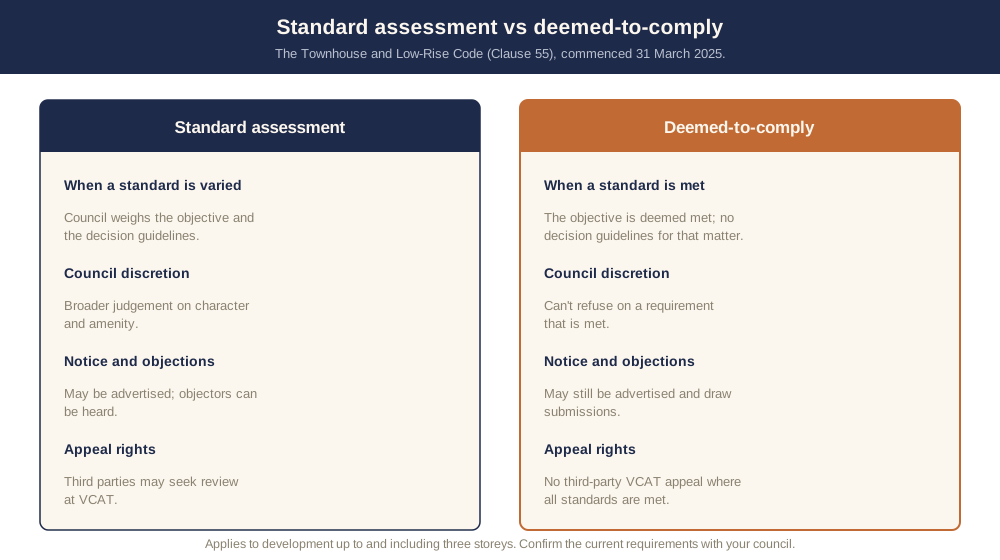
Figure 3: Meeting every applicable standard moves a townhouse design onto the deemed-to-comply pathway, with reduced council discretion and no third-party appeal.
There's also a meaningful change to objection rights. Councils may still advertise an application and accept submissions, but where a proposal meets all the relevant deemed-to-comply standards, third-party appeal rights to VCAT are removed for those matters — the state's view is that the Code already builds in strong neighbour protections. None of this removes the permit requirement; it changes how the permit is assessed. As always, the exact outcome depends on your zone, any overlays and your specific design, so confirm the current requirements with your council.
Garden area, height and the standards that shape your design
Two requirements catch out a lot of first-time townhouse projects.
The minimum garden area requirement applies to lots of 400 square metres or more in the General Residential and Neighbourhood Residential Zones, and it applies to multi-dwelling developments, not just single houses. It is a mandatory percentage of the lot set aside as garden area at ground level, and it cannot generally be reduced.
- ✓400–500 m² lot — 25% garden area
- ✓501–650 m² lot — 30% garden area
- ✓Over 650 m² lot — 35% garden area
- ✓Garden area excludes driveways, parking, buildings and any strip under 1 m wide
On building height, the General Residential Zone is a three-storey zone with a default maximum building height of 11 metres where the schedule doesn't specify otherwise. That ceiling, combined with the three-storey scope of Clause 55, is why most townhouse developments are designed as two or three storeys. Always check your zone schedule, because it can vary the default.
Subdividing your townhouses
Building the townhouses and selling them as separate titles are two different approvals. Once the dwellings are approved (and usually once they're built), you subdivide the land so each townhouse sits on its own lot. That subdivision needs its own planning permit — a permit to subdivide, separate from the permit to develop — and the Plan of Subdivision (PS) is typically lodged electronically through SPEAR.
The development permit and the subdivision permit are often run in sequence, and the subdivision is assessed against the scheme's subdivision provisions, which the 2025 Code did not change. If you're planning to sell the townhouses individually, budget for both approvals from the start. We cover the second step in do I need a planning permit for a multi-lot subdivision in Victoria.
Get your townhouse report ready before you lodge
A townhouse application is strong — and far less likely to be returned or hit a Request for Further Information — when it's backed by a town planning report that works methodically through Clause 55, your zone and any overlays, and shows where the design meets each deemed-to-comply standard.
Hiring a town planner can take weeks. instantplanning builds the same council-ready report from current Victorian planning scheme data in minutes — you review it before you lodge. If your project is two dwellings rather than several, start with do I need a planning permit for a dual occupancy in Victoria, see do I need a planning permit in Victoria for the basics, or just generate your report.
Frequently asked questions
Do townhouses always need a planning permit in Victoria?
What is Clause 55, the Townhouse and Low-Rise Code?
What does deemed-to-comply mean under the 2025 Code?
How tall can a townhouse be in the General Residential Zone?
Is there a garden area requirement for townhouses?
Do I need a separate permit to subdivide my townhouses?
Ready to generate your report?
Skip the writing. Get a council-ready town planning report in 5 minutes.
Get your report