Key takeaways
- ✓ResCode lets you build a wall on a side or rear boundary, but caps how long and how tall it can be.
- ✓The default length limit is 10 metres plus 25% of the remaining boundary, unless a zone schedule sets a different figure.
- ✓A boundary wall should average no more than 3.2 metres and reach no higher than 3.6 metres.
- ✓The standard is Clause 54.04-2 for one dwelling and Clause 55.04-2 for two or more.
- ✓A wall set back up to 200 millimetres still counts as on the boundary for this rule.
Walls on Boundaries (VIC): ResCode Limits
When you build on a tight Victorian lot, putting a wall directly on the side or rear boundary can be the difference between a workable design and a cramped one. ResCode allows it — a carport, garage or single-storey extension is often handled this way — but it does not let you wall a neighbour in. The standard caps how long and how tall a boundary wall can be, and those two numbers decide whether your design complies or needs to be argued.
Get a council-ready town planning report in 5 minutes — no town planner, no waiting.
Get your report →- ✓When ResCode lets you build a wall on the boundary
- ✓The length limit and the 10-metres-plus-25% formula
- ✓The average and maximum height limits
- ✓What counts as a wall "on" the boundary
- ✓How to show the boundary wall working in your application
The short answer
ResCode allows a wall on a side or rear boundary, but it should not run for more than the length set by a zone schedule — or, by default, 10 metres plus 25% of the remaining boundary length. The wall should average no more than 3.2 metres high and reach no higher than 3.6 metres, unless it abuts a higher existing wall.
The rule lives in Clause 54.04-2 for one dwelling and Clause 55.04-2 for two or more. The diagram below shows the two limits the standard sets.
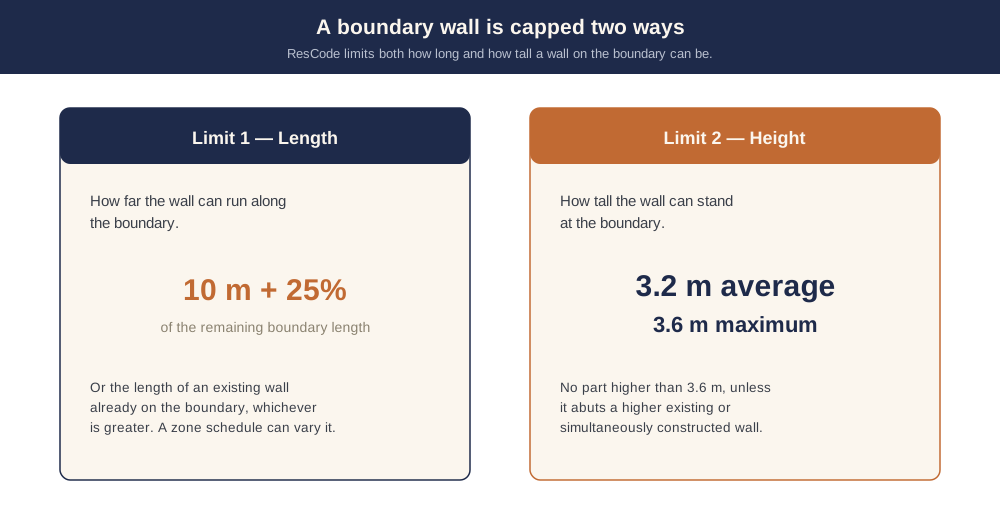
Figure 1: A boundary wall is capped on both length and height — confirm the exact figures for your zone with your council.
Where the rule lives
The walls-on-boundaries standard appears once in each ResCode pathway. For one dwelling on a lot — the Single Home Code — it is Clause 54.04-2, Standard A11. For two or more dwellings — the Townhouse and Low-Rise Code — it is Clause 55.04-2, Standard B18. The objective and the figures are the same in both, because the amenity concern is identical: a wall on the boundary should not dominate the neighbouring property.
Like every ResCode provision, it runs on deemed-to-comply logic. Meet the standard and the objective is treated as satisfied; miss it and the council weighs your design against the decision guidelines instead. The foundations are covered in what is ResCode. Note that the residential provisions were amended in September 2025; the height and length tests for boundary walls were retained and clarified rather than replaced, but you should always confirm the current wording against your scheme.
The length limit
Spend 5 minutes, not 3 weeks
instantplanning generates a council-ready town planning report for Victorian permits. No town planner. No waiting.
Get your report →The headline control is on length. A new wall built on, or within 200 millimetres of, a side or rear boundary should not abut that boundary for a length greater than the figure in a schedule to the zone — or, where no figure is specified, the greater of two numbers.
- ✓10 metres plus 25% of the remaining length of the boundary of the adjoining lot
- ✓Or, where there are existing or simultaneously constructed walls already abutting the boundary, the combined length of those walls — whichever is greater
In practice the formula is read as 10 metres plus a quarter of whatever boundary length remains beyond the first 10 metres. So on a 30-metre boundary, the wall can run 10 metres plus 25% of the remaining 20 metres — that is, 10 plus 5, giving 15 metres. The second limb matters when a neighbour already has a wall on the shared boundary: you can match its length even if the formula would otherwise be shorter, which is how paired garages and back-to-back carports are commonly approved.
A schedule to the residential zone can set a different length entirely, which is why an identical garage can comply in one street and overrun in another. Confirm the figure for your own lot rather than relying on the default.
The height limit
The second control is on height, and it has two parts. A wall on or within 200 millimetres of a side or rear boundary should not exceed an average height of 3.2 metres, and no part of it should be higher than 3.6 metres — unless it abuts a higher existing or simultaneously constructed wall.
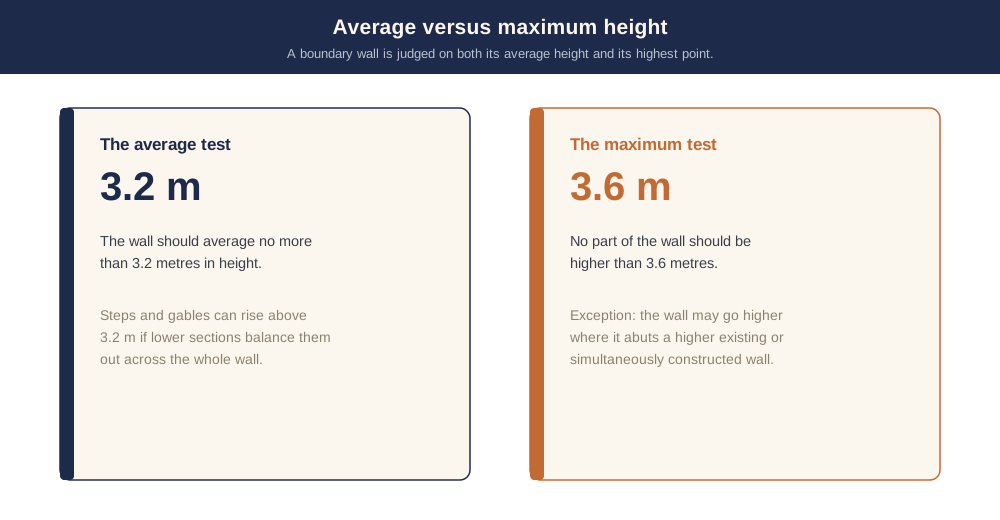
Figure 2: A boundary wall is judged on both its average and its highest point — read your scheme and confirm the numbers with your council.
The average lets a wall step or gable above 3.2 metres in places, provided the high points are balanced by lower sections and nothing breaks 3.6 metres. The exception for abutting a higher wall is what allows a new wall to match a neighbour's taller existing boundary wall, so the two read as a single structure rather than a mismatched step. Where the site slopes and the effective height on the abutting property is under 2 metres, a wall or carport can sometimes fully abut the boundary — a point worth checking on a sloping block.
What counts as "on" the boundary
A subtle but important point: the standard treats a wall as on the boundary if it sits up to 200 millimetres from it. You cannot escape the length and height caps by nudging the wall 100 millimetres off the line — it is still assessed as a boundary wall. A carport is treated similarly when built on or within 1 metre of the boundary.
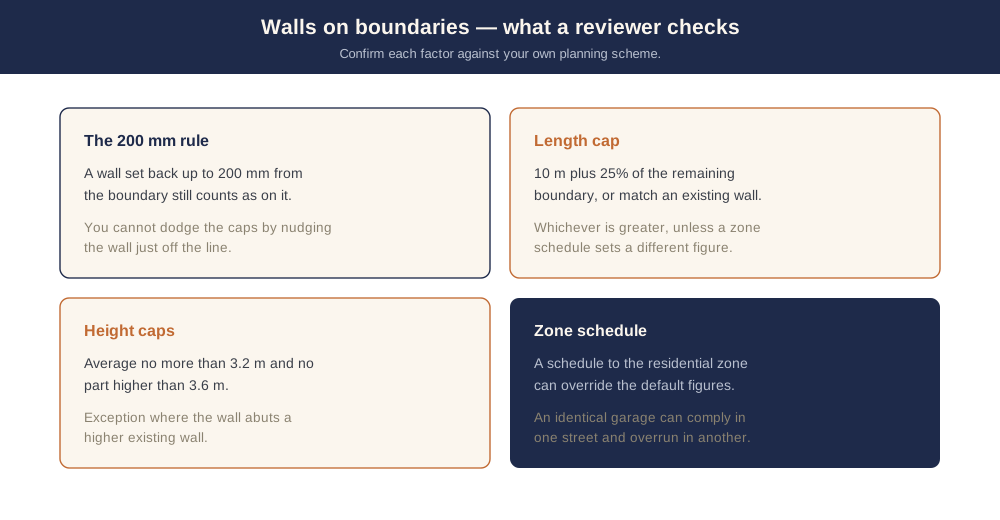
Figure 3: The factors behind a walls-on-boundaries assessment — confirm each against your planning scheme.
This is why the boundary wall and the side and rear setback standards are read as a pair. Either you set the wall back to the height-based formula, or you build it on the boundary within these length and height caps — but a wall sitting awkwardly just off the line gets the worst of both. Decide which path your design takes early, because it changes how the whole boundary is drawn and how the impact on neighbourhood character is argued.
Showing the boundary wall in your application
If your project needs a permit, your town planning report has to set out each boundary wall — its length against the formula or schedule, its average and maximum height, and, where you exceed a figure, how the design meets the decision guidelines. A boundary wall that overruns the length cap without explanation is a common trigger for a request for further information, which stops the clock on your application.
Hiring a town planner can take weeks. Start with what a town planning report is, or generate your report. For a complex or contested boundary, engage an experienced human planner.
You can confirm the current standard wording on the Victorian residential provisions guidance.
Frequently asked questions
Can I build a wall on my side boundary in Victoria?
How tall can a boundary wall be?
How long can a wall on the boundary be?
Does a wall just off the boundary count?
Which clause covers walls on boundaries?
Can I match a neighbour's existing boundary wall?
Ready to generate your report?
Skip the writing. Get a council-ready town planning report in 5 minutes.
Get your report