Key takeaways
- ✓Yes — you can legally prepare and lodge your own town planning report in Victoria; town planning is not a licensed or registered profession.
- ✓The council assesses whether the report correctly addresses the scheme — your zone, overlays and ResCode — not who wrote it.
- ✓The biggest risk is an incomplete report that triggers a section 54 information request and stops your 60-day clock.
- ✓A self-prepared report is realistic for straightforward proposals; heritage, complex overlays and contested matters are harder to do well alone.
- ✓instantplanning gives you a council-ready report from current scheme data in minutes, which you review before you lodge.
Can I Prepare My Own Planning Report? (VIC)
If you are weighing up the fee a planner charges, it's reasonable to ask whether you can simply write the town planning report yourself. In Victoria, the short answer is yes — there's no law stopping you. The longer answer is that the report still has to do a specific job, and the difference between a report that sails through and one that stalls comes down to completeness and accuracy, not who typed it.
Get a council-ready town planning report in 5 minutes — no town planner, no waiting.
Get your report →- ✓Whether it is legal to prepare and lodge your own planning report in Victoria
- ✓What the council actually assesses when your report lands
- ✓What a self-prepared report must contain
- ✓The pitfalls that stall a DIY application
- ✓When doing it yourself is realistic, and when it isn't
The short answer
Yes — you can legally prepare and lodge your own town planning report in Victoria. Town planning is not a licensed or registered profession, so there is no requirement to use a registered planner. The council assesses whether the report correctly addresses your zone, overlays and ResCode — not who wrote it. Completeness and accurate data are what matter.
The detail below explains how to do it well, and where the real risks sit.
Is it legal to prepare your own report?
It is. Unlike a building surveyor, no statutory registration gatekeeps who may prepare a planning report in Victoria. The Victorian Government's guidance on applying for a planning permit addresses the applicant simply as "you" and never requires a registered planner to prepare the documents.
Membership of the Planning Institute of Australia is voluntary and fee-based — a quality signal for human planners, not a legal precondition for lodging a report. So the choice is genuinely yours.
What the council actually assesses
Spend 5 minutes, not 3 weeks
instantplanning generates a council-ready town planning report for Victorian permits. No town planner. No waiting.
Get your report →Understanding what the council looks for makes a self-prepared report far more achievable, because the task is more structured than it first appears. The council — your responsible authority under the Planning and Environment Act 1987 — assesses your proposal against the planning scheme: the correct zone, every applicable overlay, the relevant state and local policy, particular provisions, and ResCode (Clause 54 for one dwelling, Clause 55 for two or more).
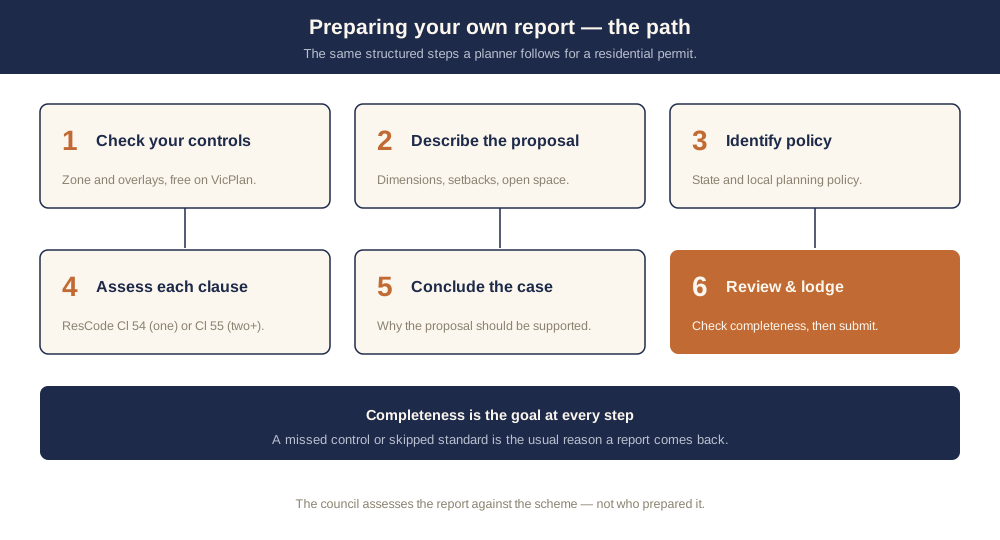
Figure 1: The steps to prepare your own report, the same path a planner follows.
None of those steps require professional judgement in the abstract — they require you to find the right controls and respond to each one. The controls themselves are public: you can view your zone and overlays free on VicPlan.
What your report must contain
A council-ready report follows a recognisable structure, and a missing section is the usual reason one comes back. Your report should cover the site and its context, a clear description of the proposal, the planning controls that apply, a clause-by-clause assessment against the scheme and ResCode, and a reasoned conclusion on why the proposal should be supported.
- ✓Site and context description
- ✓Clear proposal description with key dimensions
- ✓Correct zone and all overlays identified
- ✓Relevant state and local policy
- ✓Clause-by-clause ResCode assessment
- ✓A reasoned conclusion supporting the proposal
Get those elements right and the report is doing what the council needs. The hard part isn't writing prose — it's making sure nothing is missed. See what's in a town planning report for a full section-by-section breakdown.
The pitfalls that stall a DIY application
The biggest risk of going it alone is not illegality — it's an incomplete report that slows everything down. A council generally has 60 statutory days to decide a standard permit application. But if it issues a section 54 request for further information, the statutory clock stops until you respond, and once the information is accepted the count can restart from zero. The most common trigger is a report that misses a control or leaves a ResCode standard unaddressed.
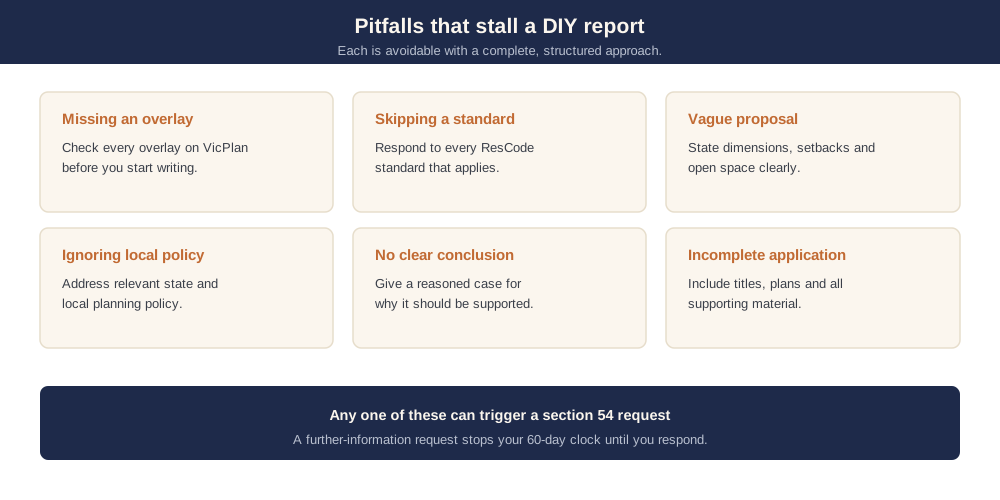
Figure 2: The pitfalls that most often stall a self-prepared report — and how to avoid each.
The pitfalls are predictable: missing an overlay, skipping a ResCode standard, describing the proposal too vaguely, or ignoring relevant local policy. Each one is avoidable with a complete, structured approach — which is precisely where a tool that works from current scheme data helps. If your project is simple, it may even qualify for the VicSmart pathway, with a 10 business-day decision timeframe and set application requirements; on that track you usually won't need a full report at all.
A second, quieter pitfall is misreading the controls rather than missing them — for example, applying the wrong ResCode pathway by treating a two-dwelling proposal as a single dwelling, or assuming an overlay's requirements without reading its schedule. These mistakes don't always bounce the application straight back, but they weaken the case and invite questions during assessment. The defence is the same as for completeness: work systematically from the current scheme, respond to the actual clause that applies, and don't assume. When you're unsure how a particular control reads, the planning scheme text is public, and you can always confirm the interpretation with your council before you lodge.
When doing it yourself is realistic
A self-prepared report is a strong fit for the structured, everyday cases and a poor fit for the genuinely hard ones. Be honest about which yours is.
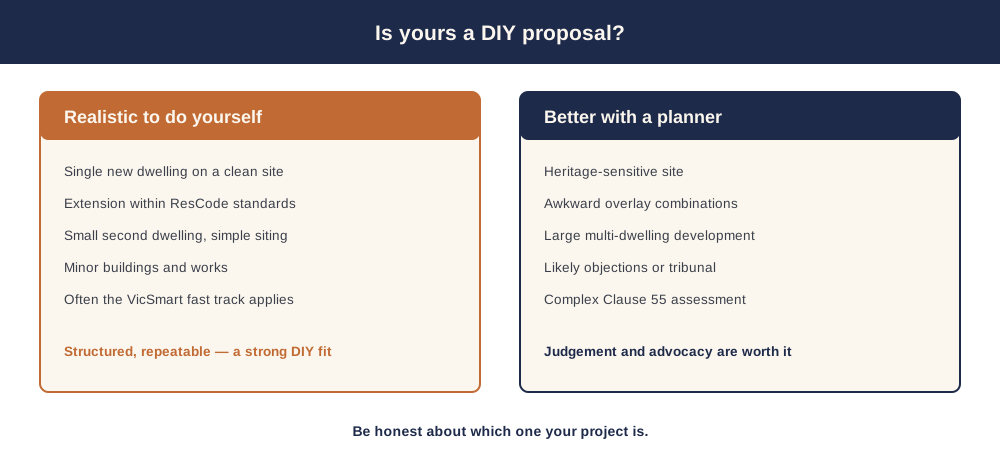
Figure 3: Matching your proposal to a self-prepared report or a human planner.
Doing it yourself is realistic for a single dwelling, an extension, or a small second dwelling on a site without difficult controls. It is much harder to do well on heritage-sensitive sites, awkward overlay combinations, large multi-dwelling developments, or proposals likely to attract objections — those benefit from a planner's judgement and advocacy. See DIY town planning report for a step-by-step walkthrough, and town planning consultant for when to bring in help.
A faster way to do it yourself
Preparing your own report doesn't have to mean starting from a blank page. instantplanning builds a council-ready town planning report from current Victorian planning scheme data in minutes — it identifies your zone and overlays and works clause-by-clause through ResCode, so the completeness problem is solved for you. You review every line before you lodge, staying fully in control. Compared with weeks of waiting for a planner, it's the self-prepared route without the risk of a missed control.
Ready to start? Generate your report.
Frequently asked questions
Can I legally prepare my own town planning report in Victoria?
Will the council take a self-prepared report seriously?
What does my report need to include?
What's the biggest risk of doing it myself?
When should I not prepare my own report?
Is there a faster way than writing it from scratch?
Ready to generate your report?
Skip the writing. Get a council-ready town planning report in 5 minutes.
Get your report