Key takeaways
- ✓Council planning application fees are set statewide by the Planning and Environment (Fees) Regulations 2016 — every council charges the same.
- ✓The fee depends on the class of application — use only, single dwelling, other development, or subdivision — and the estimated cost of development.
- ✓VicSmart applications are charged much lower fees than standard ones.
- ✓Always confirm the current figure on the official fees page, as fee-unit values change each year.
Council Planning Application Fees in Victoria
Council planning application fees in Victoria are set statewide by the Planning and Environment (Fees) Regulations 2016 — so the council fee for a given application is the same whether you lodge in Melbourne, Geelong or Bendigo. What you pay depends on the class of application and, for most development, the estimated cost of development. This guide explains how those classes work and gives the current figures.
Get a council-ready town planning report in 5 minutes — no town planner, no waiting.
Get your report →- ✓How Victorian planning fees are set, and why they are the same across councils
- ✓The fee classes for use, single dwellings, other development and subdivision
- ✓How VicSmart applications are charged
- ✓What public notice and other charges to expect
- ✓Where to confirm the current figure for your application
The short answer
Council planning application fees in Victoria are statutory, set by the Planning and Environment (Fees) Regulations 2016, and identical at every council. The fee is determined by the application's class — use only, single dwelling, other development, or subdivision — and, for development, by the estimated cost of development. Lower-cost projects and VicSmart applications pay much less.
The figure below shows how the class determines the fee.
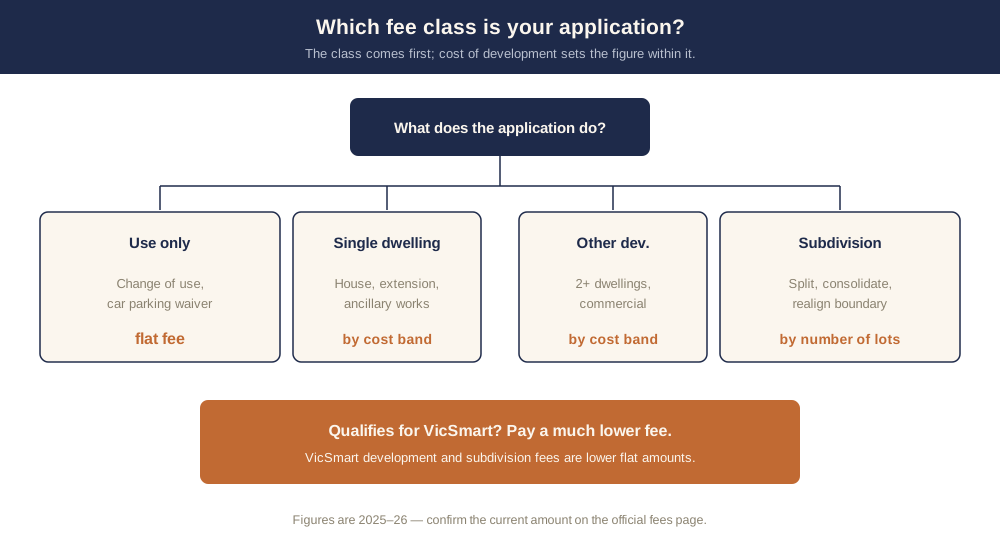
Figure 1: Your application's class — and for development, its estimated cost — set the statutory fee. The class comes first.
Because the figures are tied to a fee unit that the government revalues each financial year, always confirm the current amount on the official page before you budget. The structure below reflects the 2025–26 schedule.
How the fees are set
Planning application fees are not a charge each council invents. They are prescribed by regulation under the Planning and Environment Act 1987 and expressed in fee units, which the state revalues annually. The Department of Transport and Planning publishes the current converted dollar figures on its fees page. That is why the council fee is the same statewide — it is the law, not local policy.
Fee classes for use and development
Spend 5 minutes, not 3 weeks
instantplanning generates a council-ready town planning report for Victorian permits. No town planner. No waiting.
Get your report →The regulations sort applications into classes. For everyday residential and commercial work, these are the ones that matter, with current 2025–26 figures.
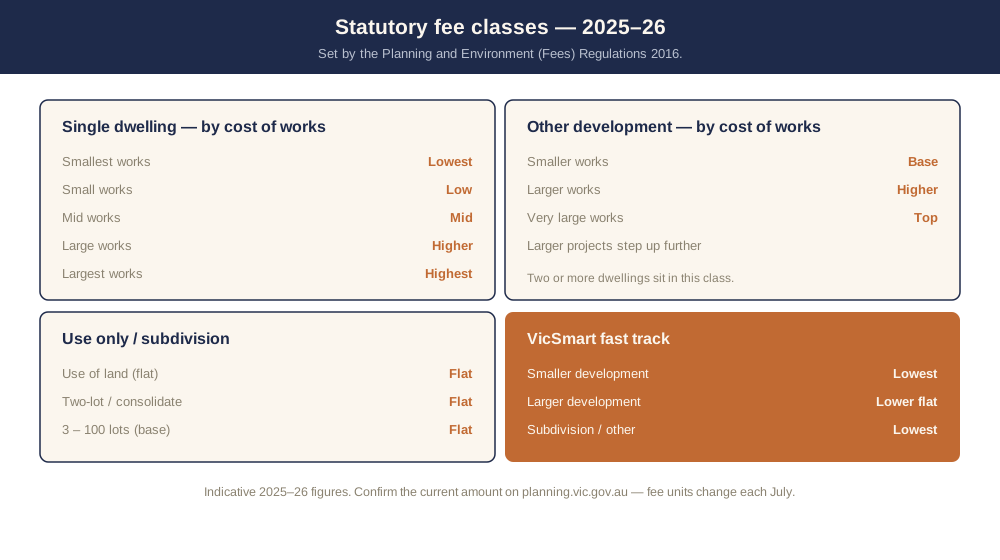
Figure 2: The main statutory fee classes for 2025–26. Single-dwelling and other-development fees step up by estimated cost of development.
Use only. An application to use land (for example a change of use, or a reduction of car parking) is a flat fee — set by regulation — and is not based on cost of works.
Single dwelling, use and/or develop. For a single dwelling or works ancillary to it, the fee steps up in bands by the estimated cost of development — the more your works are worth, the higher the band. See the permit cost calculator or the official fees page for the current figure in each band.
Other development. For everything else — commercial, industrial, and two or more dwellings — the fee sits in a higher set of bands than a single dwelling, again rising with the estimated cost of development. Check the current figure for your band on the permit cost calculator.
These figures are indicative of the 2025–26 schedule; confirm the exact current amount for your class on the official fees page, because the fee-unit value changes each July.
Subdivision fees
Subdivision is charged under its own classes, based on the number of lots rather than the cost of works. Subdividing into two lots, realigning a boundary, or consolidating attracts a flat base fee that also covers subdividing into 3 to 100 lots — with the fee stepping up in blocks above 100 lots. These are separate from your surveyor's fees and the Plan of Subdivision (PS) registration costs, which we cover in how much a subdivision costs in Victoria.
VicSmart application fees
If your proposal qualifies for the VicSmart fast track, the application fee is much lower than the standard equivalent. The VicSmart development fee is a low flat amount, with a single step up once the cost of development passes a set threshold; a VicSmart subdivision or other VicSmart application sits at the lower figure. This is one of the real savings of the VicSmart pathway — a fraction of the standard fee, on a 10 business-day timeframe. Since amendment VC288 in October 2025, more proposals — including some dual occupancies and two-lot subdivisions — qualify, so it is worth checking before you assume the standard fee applies.
Public notice and other charges
Beyond the application fee, two further costs commonly arise. Public notice (advertising) is not set by the state regulations — each council charges its own amount, often per property notified, plus the cost of any sign or newspaper notice, so it varies by council and by how many neighbours must be notified. There can also be fees for amending an application or permit, and for requesting secondary consent or an extension of time later. Budget for notice as a separate, council-set line item rather than assuming it is folded into the application fee.
Why the report cost is separate
It is worth repeating, because it trips people up: the council application fee above is not the cost of preparing your town planning report. The application fee is the statutory charge the council takes to assess your proposal; the report is the document that makes your case, and you pay for it separately.
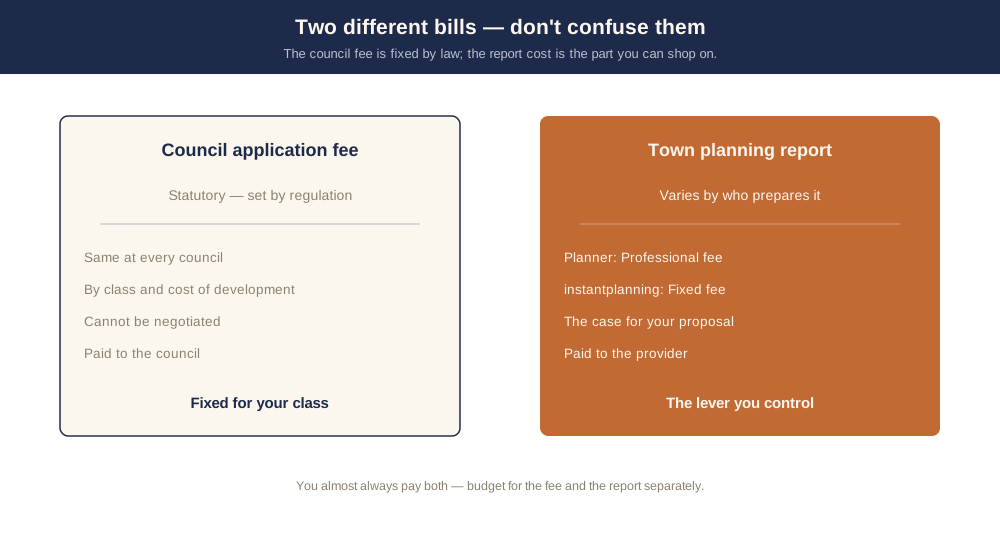
Figure 3: Two different bills. The council fee is fixed by regulation; the report cost is the part you can shop on.
We break that down in the town planning report cost guide and in the hidden costs of a planning permit.
Budget for both — and get the report right
The council application fee is fixed by regulation, so the part you can control is the quality of the town planning report you lodge with it — and a complete report is what stops your application being returned or hit with a Request for Further Information, either of which costs far more than any fee.
Hiring a town planner can take weeks. instantplanning builds the same council-ready report from current Victorian planning scheme data in minutes — you review it before you lodge. See the town planning report cost, check the overall planning permit cost, or generate your report.
Frequently asked questions
How much is a council planning application fee in Victoria?
Do different councils charge different planning fees?
How much is a VicSmart application fee?
How much is the planning fee for a subdivision?
Where can I find the current planning fee for my application?
Is the application fee the same as the cost of my planning report?
Ready to generate your report?
Skip the writing. Get a council-ready town planning report in 5 minutes.
Get your report