Key takeaways
- ✓Casey planning runs under the Casey Planning Scheme.
- ✓Clyde and Cranbourne sit in major urban growth areas.
- ✓Development plan controls shape much new housing.
- ✓A report must address zone, overlays and ResCode.
Town Planning Reports for Casey City
Casey is the largest and one of the fastest-growing municipalities in Victoria — the engine room of south-eastern Melbourne's expansion. Clyde and Clyde North are among the busiest housing fronts in the country, while Cranbourne, Berwick, Narre Warren and Hampton Park form the established suburban core. If you are building here, your permit is decided under the Casey Planning Scheme, and a town planning report is what shows the council your proposal fits.
Casey City Council is your responsible authority. In a municipality defined by growth, what shapes most applications is the framework of growth-area planning — precinct structure plans, development plans and contributions — layered over the standard residential controls.
Get a council-ready town planning report in 5 minutes — no town planner, no waiting.
Get your report →Do you need a town planning report in Casey?
You need a town planning report in Casey whenever your proposal triggers a planning permit under the Casey Planning Scheme — through the residential or urban growth zone provisions, a development plan or contributions overlay in the growth areas, or design, flood and heritage overlays elsewhere. In the new estates, the growth-area controls are usually the decisive factor; in the older suburbs, it is the residential zone and any overlay on the land.
What decides it is the combination of your zone, the overlays on the land, and the use or works you propose.
Common zones and overlays in Casey
Casey's major growth areas at Clyde and Clyde North are built on the Urban Growth Zone, which carries new residential land through precinct structure plans into development. The established suburbs use the General Residential Zone and Neighbourhood Residential Zone, with the Low Density Residential Zone in selected areas and a Green Wedge Zone across the southern rural land.
The overlays reflect a growth municipality. The Development Plan Overlay and Development Contributions Plan Overlay govern how new estates are planned and funded, and the Design and Development Overlay manages built form in activity centres and selected precincts. The Heritage Overlay protects identified places — Casey applies a dedicated growth-area heritage approach to sites caught up in expansion — while the Land Subject to Inundation Overlay and Special Building Overlay manage flood-prone land along creeks such as Eumemmerring Creek, and a Significant Landscape Overlay applies in selected areas.
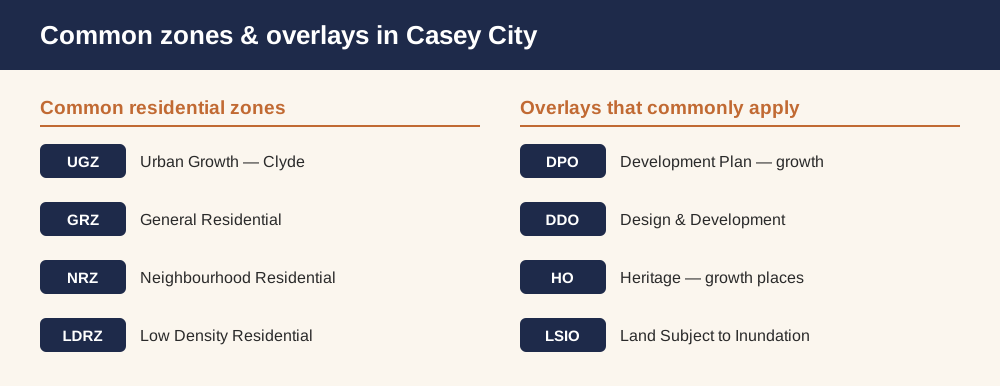
Figure 1: The zones used across Casey's growth areas and established suburbs, and the overlays most likely to require a permit and a report.
Confirm your controls for free on VicPlan or a planning property report. In Casey, the first thing to check is whether your land sits within a development plan or precinct structure plan, which sets much of what you can do.
What a town planning report must address here
Spend 5 minutes, not 3 weeks
instantplanning generates a council-ready town planning report for Victorian permits. No town planner. No waiting.
Get your report →A Casey report identifies your zone — urban growth, general or neighbourhood residential — and its controls, then addresses each overlay. In the growth areas that means demonstrating consistency with the relevant precinct structure plan and development plan, and the contributions framework; elsewhere it means responding to design, flood or heritage controls as they apply.
- ✓Zone purpose and the residential or growth controls
- ✓Development Plan and contributions overlays in the growth areas
- ✓Design and Development Overlay — built form in centres and precincts
- ✓Flood and heritage overlays where they apply
- ✓ResCode (Clause 54 or 55) siting, setbacks and amenity
Beneath the overlay responses sits ResCode — Clause 54 for a single dwelling, Clause 55 for two or more — applied to both new estates and established Casey streets.
How to lodge a planning permit with Casey
Casey City Council accepts planning permit applications through the Victorian State Planning Permit Application Service (VSPPAS) and the council website, as well as by email and in person at the Bunjil Place civic offices in Narre Warren. Subdivision applications — a constant in the growth areas — are lodged through SPEAR, the state electronic system. Simple proposals may run on the VicSmart 10 business-day pathway.
Get your Casey report ready
A town planner typically takes weeks to prepare a report. instantplanning assembles a council-ready town planning report from current Casey Planning Scheme data in minutes, built around your zone and overlays — including growth-area and design controls — for you to review before lodging.
Start with the free planning permit checker, estimate fees with the permit cost calculator, or use the document checklist. For background, read do I need a planning permit in Victoria and what a town planning report is, or browse town planning reports by council — then generate your report.
Frequently asked questions
Which planning scheme applies in Casey?
Is my Casey land in a growth area?
What does a town planning report for Casey need to cover?
How do I lodge a planning permit with Casey?
Can I prepare my own Casey planning report?
Ready to generate your report?
Skip the writing. Get a council-ready town planning report in 5 minutes.
Get your report